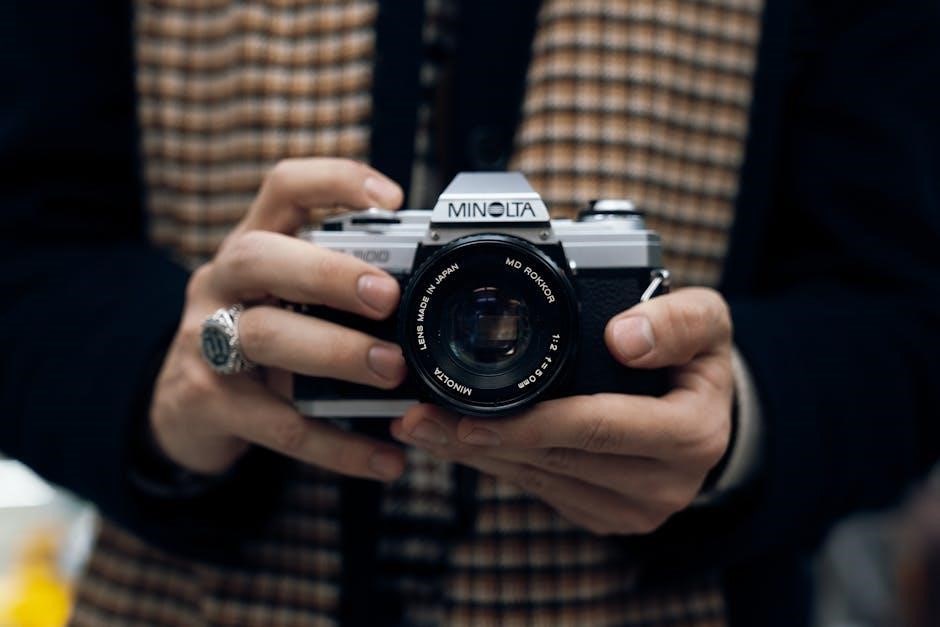
Minolta Maxxum 5 Manual: A Comprehensive Guide
Konica Minolta provides solutions anticipating future challenges, offering diagnostic imaging, office printers, and surveillance systems with robust support and downloadable resources.
The Minolta Maxxum 5, also known as the Dynax 5 or Alpha Sweet II, represents a significant entry point into the world of 35mm SLR photography. Konica Minolta’s commitment to innovation shines through this model, offering a blend of affordability and functionality. This manual serves as a comprehensive resource, guiding users through every aspect of the camera’s operation.
From understanding its core features to mastering advanced settings, this guide aims to unlock the full potential of your Maxxum 5. Konica Minolta’s dedication to anticipating user needs is reflected in the camera’s design and capabilities, making it a reliable companion for both beginners and experienced photographers alike.
Understanding the Camera’s Key Features
The Minolta Maxxum 5 boasts a versatile feature set, including multiple shooting modes – Program, Aperture Priority, Shutter Priority, and Manual – offering creative control; Its autofocus system ensures sharp images, while various metering modes optimize exposure. Konica Minolta prioritized user accessibility, integrating intuitive controls and a clear interface.
Furthermore, the camera supports external flash units, expanding its capabilities in challenging lighting conditions. Konica Minolta’s dedication to quality is evident in its robust build and reliable performance, making it a valuable tool for photographers of all levels.

Camera Components and Controls
The Minolta Maxxum 5 features a well-designed body, compatible lenses, and an easily navigable control dial with buttons for intuitive operation and settings.
Body and Exterior Features
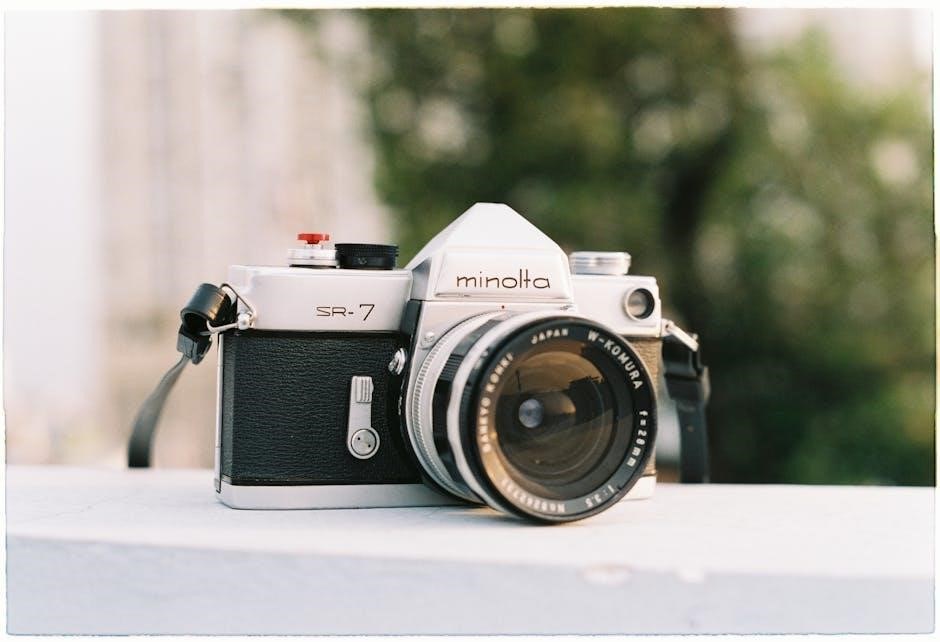
The Minolta Maxxum 5 boasts a robust and ergonomically designed body, providing a comfortable grip for extended shooting sessions. Its exterior showcases a durable construction, intended for reliable performance in various conditions. The camera’s layout prioritizes accessibility to key controls, streamlining adjustments during operation. Konica Minolta focused on creating a user-friendly experience, evident in the placement of buttons and dials. The overall design balances functionality with a compact form factor, making it suitable for diverse photographic pursuits. It’s a well-built camera designed for practical use.
Lens Mount and Compatibility
The Minolta Maxxum 5 utilizes the Minolta A-mount, a bayonet mount system renowned for its secure lens attachment and electronic communication. This compatibility extends to a wide range of Minolta and Konica Minolta A-mount lenses, offering photographers diverse options. Adapters are also available, enabling the use of lenses from other manufacturers. The A-mount facilitates autofocus and aperture control, enhancing shooting flexibility. Ensuring proper lens functionality requires a clean mount and secure connection, vital for optimal image quality and performance.
Control Dial and Buttons Explained
The Minolta Maxxum 5’s control dial facilitates adjustments to shooting settings like aperture, shutter speed, and exposure compensation, depending on the selected mode. Dedicated buttons provide quick access to essential functions, including autofocus, drive mode, and ISO. The menu button navigates the camera’s settings, allowing customization of features. Understanding each control’s function is crucial for efficient operation and achieving desired photographic results. Familiarity with these controls unlocks the camera’s full potential.
Basic Operation and Setup
Initial setup involves installing batteries and a memory card, then accurately setting the date and time for proper image organization and metadata tagging.
Installing Batteries and Memory Card
Powering the Minolta Maxxum 5 requires proper battery installation; typically, this camera utilizes AA batteries, inserted into the designated compartment following the polarity markings. Ensure a fresh set for optimal performance.
Memory card insertion is equally crucial for storing your captured images. The Maxxum 5 is compatible with CompactFlash (CF) cards. Locate the card slot, gently insert the CF card until it clicks into place, and verify it’s securely seated.
Always power off the camera before battery or card operations to prevent data corruption or damage to the device.
Setting the Date and Time
Accurate date and time are essential for proper image organization and metadata. Access the camera’s menu using the appropriate buttons, navigating to the ‘Date/Time Set’ option. Utilize the control dial to adjust the year, month, day, hour, and minute.
Confirm each setting by pressing the ‘Set’ or ‘OK’ button.
Ensure the correct date and time format (MM/DD/YYYY or DD/MM/YYYY) is selected within the menu settings. Incorrect settings can lead to chronological errors in your photo library.
Choosing Shooting Modes
The Minolta Maxxum 5 offers diverse shooting modes to suit various photographic scenarios. These include Program (P) mode for automatic settings, Aperture Priority (A) for depth-of-field control, and Shutter Priority (S) for motion blur or freezing action.
Manual (M) mode grants full creative control.
Selecting the appropriate mode via the mode dial is crucial for achieving desired results. Consider the subject and lighting conditions when making your selection.

Shooting Modes in Detail
Explore the Maxxum 5’s Program, Aperture Priority, Shutter Priority, and Manual modes for tailored control over your images and creative expression.
Program Mode (P)
Program Mode on the Minolta Maxxum 5 offers a versatile, automatic shooting experience, ideal for everyday photography. The camera intelligently selects both the aperture and shutter speed based on the lighting conditions and scene.
However, unlike fully automatic modes, Program mode allows for limited user intervention. Photographers can adjust exposure compensation to fine-tune brightness, and utilize other settings like white balance and ISO. This provides a balance between convenience and creative control, making it suitable for various shooting scenarios where quick results are desired without complex manual adjustments.
Aperture Priority Mode (A)
Aperture Priority Mode on the Minolta Maxxum 5 empowers photographers to control the depth of field, influencing which parts of the image appear in focus. You select the desired aperture (f-stop), and the camera automatically determines the appropriate shutter speed for correct exposure.
A wider aperture (lower f-number) creates a shallow depth of field, ideal for portraits, while a narrower aperture (higher f-number) maximizes depth of field for landscapes. This mode balances creative control over focus with automatic exposure settings.
Shutter Priority Mode (S)
Shutter Priority Mode on the Minolta Maxxum 5 grants photographers control over motion blur and freezing action. You choose the shutter speed, and the camera automatically adjusts the aperture to achieve proper exposure. Faster shutter speeds freeze motion, perfect for sports or wildlife photography.
Slower shutter speeds create motion blur, useful for conveying movement or in low-light situations. This mode offers a balance between controlling how motion is captured and automatic aperture adjustments.
Manual Mode (M)
Manual Mode provides complete creative control over both shutter speed and aperture on the Minolta Maxxum 5. This mode is ideal for experienced photographers who want precise control over exposure and depth of field. You independently set both values, allowing for artistic expression and challenging lighting scenarios.
Utilize the camera’s metering system as a guide, but ultimately, you dictate the final exposure. Mastering Manual Mode unlocks the full potential of the camera.
Focusing and Metering
The Maxxum 5 features an advanced autofocus system and multiple metering modes, ensuring sharp images and accurate exposures in diverse shooting conditions.
Autofocus System Overview
The Minolta Maxxum 5 boasts a sophisticated autofocus (AF) system designed for quick and precise subject acquisition. This system utilizes multiple focus points, allowing photographers to select the optimal area for focusing within the frame. The camera employs a contrast-detection autofocus method, ensuring sharpness and clarity. It offers both single-shot and continuous autofocus modes, adapting to static and moving subjects effectively. Understanding the AF system’s capabilities is crucial for capturing consistently sharp images, especially in dynamic shooting scenarios. Proper focus point selection and mode choice are key to maximizing the camera’s autofocus performance.
Focus Area Selection
The Minolta Maxxum 5 allows photographers to strategically choose the focus area, enhancing control over image sharpness. Users can select from multiple focus points distributed across the viewfinder, enabling precise targeting of the desired subject. This feature is particularly useful when composing shots with complex scenes or off-center subjects. Manual focus point selection ensures the camera prioritizes focusing on the intended area, ignoring distracting elements. Experimenting with different focus areas allows for creative control and consistently sharp results, tailored to specific photographic needs.
Metering Modes Explained
The Minolta Maxxum 5 offers several metering modes to accurately determine optimal exposure. Evaluative metering analyzes the entire scene for balanced exposure, ideal for general photography. Center-weighted metering prioritizes the center of the frame, suitable for portraits. Spot metering measures light from a very small area, perfect for challenging lighting situations. Understanding these modes allows photographers to tailor exposure to specific scenes, ensuring properly exposed images in diverse conditions and achieving desired creative effects.

Advanced Features and Settings
Konica Minolta’s cameras offer white balance adjustments, ISO sensitivity settings, and exposure compensation for refined control, enhancing image quality and creative possibilities.
White Balance Adjustment
Achieving accurate colors is crucial for photographic realism, and the Minolta Maxxum 5 provides several white balance options. Automatic White Balance (AWB) generally performs well in standard lighting conditions, but for more precise results, manual adjustments are available. Users can select from presets like Daylight, Cloudy, Fluorescent, and Tungsten, tailored to common light sources.
Custom White Balance allows photographers to manually set the white point using a gray card or white object, ensuring color accuracy in challenging or mixed lighting scenarios. Proper white balance correction eliminates unwanted color casts, resulting in natural-looking images and preserving the intended tones of the scene.
ISO Sensitivity Settings
The Minolta Maxxum 5 offers ISO settings to control the camera’s sensitivity to light, impacting image brightness and noise levels. Lower ISO values (like 50 or 100) are ideal for bright conditions, delivering cleaner images with minimal grain. Higher ISO settings (200, 400, or even higher) are beneficial in low light, allowing for faster shutter speeds to freeze motion.
However, increasing ISO introduces more digital noise. The Maxxum 5’s Auto ISO mode automatically selects an appropriate sensitivity based on the shooting conditions, balancing brightness and image quality.
Exposure Compensation
Exposure compensation on the Minolta Maxxum 5 allows you to fine-tune the camera’s automatic exposure settings. When the camera’s meter is fooled by bright or dark scenes, this feature lets you override its decision. Positive compensation (+ values) brighten the image, useful for dark subjects, while negative compensation (- values) darken it, ideal for bright scenes like snow.
Adjusting exposure compensation ensures your photos accurately reflect the intended brightness and detail.
Using the Built-in Flash
The Maxxum 5’s built-in flash offers various modes, including red-eye reduction, and is compatible with external flash units for enhanced lighting control.
Flash Modes and Settings
The Minolta Maxxum 5 provides a selection of flash modes to suit diverse shooting scenarios. Auto flash mode allows the camera to automatically determine when flash is needed, optimizing exposure. Red-eye reduction minimizes the red-eye effect in portraits by emitting a series of pre-flashes. Fill-flash mode adds light to brighten shadows in backlit situations.
Furthermore, you can disable the flash entirely for situations where natural light is preferable. The camera also supports external flash units, offering greater control over flash power and direction. Understanding these settings allows photographers to achieve optimal results in various lighting conditions, enhancing image quality and creative possibilities.
Red-Eye Reduction
The Minolta Maxxum 5 incorporates a red-eye reduction feature designed to minimize the common photographic issue where subjects’ eyes appear red due to flash reflection. This function works by emitting a series of quick, pre-flashes before the main flash fires. These pre-flashes cause the subject’s pupils to constrict, reducing the amount of light reflected back into the camera lens.
While effective, it’s important to note that red-eye reduction doesn’t always eliminate the effect entirely, especially in challenging lighting conditions. Proper technique and subject positioning can further enhance its effectiveness.
External Flash Compatibility
The Minolta Maxxum 5 is compatible with a range of external flashes, expanding creative lighting possibilities beyond the built-in flash. Konica Minolta’s flashes, designed for their Alpha/Maxxum system, offer advanced features like TTL (Through-The-Lens) metering for automatic exposure control.
Using an external flash allows for more powerful illumination, bounce flash techniques for softer lighting, and off-camera flash setups for dynamic compositions. Ensure compatibility by checking flash specifications and utilizing the camera’s hot shoe or sync terminal.

Reviewing and Managing Images
Playback mode allows image navigation, deletion, and quality setting adjustments on the Minolta Maxxum 5, ensuring efficient organization of captured photographs.
Playback Mode Navigation
Entering playback mode on the Minolta Maxxum 5 allows you to review captured images directly on the camera’s LCD screen. Utilize the control dial to scroll through your photographs, viewing them individually. Pressing the zoom buttons enables magnification for detailed inspection of image quality and focus. The information display provides shooting data like date, time, and camera settings.
Furthermore, quick review functionality allows immediate assessment after capture. Efficient navigation ensures easy image selection for deletion or further review, streamlining your workflow and maximizing storage space.
Deleting Images
To delete images on the Minolta Maxxum 5, first enter playback mode and select the desired photograph. Press the delete button – typically indicated by a trash can icon – to initiate the removal process. A confirmation prompt will appear; confirm your choice to permanently erase the image from the memory card.
You can also delete all images at once, but exercise caution! This action is irreversible. Regularly deleting unwanted photos frees up valuable storage space for future shooting sessions, optimizing camera performance.
Image Quality Settings
The Minolta Maxxum 5 offers several image quality settings, impacting file size and detail. Choose from various JPEG compression levels – Fine, Standard, and Economy – balancing quality with storage capacity. Higher quality settings produce larger files with more detail, ideal for printing.
Experiment with these options to find the best compromise for your needs. Consider the intended use of your photos when selecting the appropriate image quality setting.
Troubleshooting Common Issues
Resolve problems with error messages, focusing difficulties, or battery concerns using the service manual and Konica Minolta’s extensive support network online.
Error Messages and Solutions
Encountering an error message on your Minolta Maxxum 5 can be frustrating, but often indicates a solvable issue. Consult the comprehensive service manual for detailed explanations of each code. Common problems include battery-related errors, often resolved by replacing or fully charging the batteries.
Lens communication errors might necessitate cleaning the contacts on both the camera body and the lens. If issues persist, Konica Minolta’s support website offers downloadable resources and troubleshooting guides. Remember to check for firmware updates, as these can address known bugs and improve camera functionality.
Focusing Problems
Difficulty achieving sharp focus with your Minolta Maxxum 5 often stems from several factors. Ensure the autofocus system is correctly set for the shooting conditions and subject type. Verify the lens is securely mounted and free of obstructions.
Clean the autofocus sensor area on the camera body, as dust or smudges can interfere with performance. If using manual focus, double-check the focus ring operation. Refer to the service manual for detailed troubleshooting steps and potential solutions, including sensor calibration if necessary.
Battery Issues
If your Minolta Maxxum 5 isn’t powering on or exhibits inconsistent performance, begin by verifying the batteries are correctly installed with proper polarity. Ensure the battery contacts within the camera compartment are clean and free from corrosion; gently clean them if needed.
Try a fresh set of batteries, as older ones may not deliver sufficient power. If problems persist, consult the service manual for detailed diagnostics and potential component failures related to the power supply.
Maintenance and Care
Regular cleaning of the camera body and lens is crucial for optimal performance, alongside proper storage to prevent damage and ensure longevity.
Cleaning the Camera Body and Lens
To maintain your Minolta Maxxum 5, gently wipe the camera body with a soft, dry cloth to remove dust and fingerprints. For stubborn marks, slightly dampen the cloth with a mild cleaning solution, avoiding excessive moisture near openings.
Lens cleaning requires extra care; use a lens brush to remove loose particles, followed by lens cleaning paper and solution, applying gentle circular motions.
Never use harsh chemicals or abrasive materials, as these can damage the coatings. Regular cleaning ensures clear images and prolongs the camera’s lifespan.
Storage Recommendations
Proper storage is crucial for preserving your Minolta Maxxum 5’s functionality. When not in use, store the camera in a cool, dry place, away from direct sunlight and extreme temperatures.
Consider using a camera bag or case to protect it from dust, moisture, and accidental impacts. Remove batteries to prevent corrosion and potential damage.
Avoid storing the camera in humid environments, which can lead to fungal growth and internal damage. Regular use is also beneficial for maintaining its condition.
Service Manual Availability
The service manual for the Minolta Maxxum/Dynax 5 and Alpha Sweet II 35mm SLR cameras is available online. Konica Minolta Business Solutions, U.S.A., Inc. offers comprehensive support and downloads through their official website.
Accessing this manual provides detailed schematics and repair instructions for advanced users and technicians. It’s a valuable resource for troubleshooting complex issues and performing maintenance.
Further resources, including forums and communities, can offer assistance and shared knowledge regarding camera repair and upkeep.

Resources and Support
Konica Minolta offers a support website, online forums, and communities for assistance. Downloadable software, drivers, and service manuals are readily available.
Konica Minolta Support Website
Konica Minolta’s official support website is a central hub for owners seeking assistance with their products, including legacy cameras like the Maxxum 5. Users can access a comprehensive database of frequently asked questions, troubleshooting guides, and downloadable resources. The site provides access to the latest software and driver updates, ensuring optimal performance and compatibility.
Furthermore, you can locate authorized sales and service locations nearby, request a personalized quote for services, or directly contact their dedicated customer care team for personalized support. The website also features detailed product information, news, and insights into Konica Minolta’s broader range of solutions.
Online Forums and Communities
Numerous online forums and communities dedicated to classic film photography offer invaluable support for Minolta Maxxum 5 users. These platforms serve as vibrant spaces where enthusiasts share knowledge, troubleshooting tips, and repair advice. Members frequently discuss camera operation, lens compatibility, and creative techniques.
Dedicated threads often contain scanned manuals, user-submitted reviews, and links to helpful resources. Engaging with these communities provides access to a wealth of collective experience, fostering a collaborative learning environment for both novice and experienced photographers.
Service Manual Download Location
Locating the service manual for the Minolta Maxxum/Dynax 5 (and Alpha Sweet II) can be challenging, but resources exist online. While Konica Minolta’s official website doesn’t directly host these older documents, dedicated photography archive sites often provide downloadable copies. Searching specifically for “Minolta Maxxum 5 service manual PDF” yields results.
Be cautious when downloading from unofficial sources, ensuring the file is safe and virus-free. These manuals contain detailed schematics and repair instructions for advanced users and technicians.